Tuesday, March 31, 2009

Taoist Deity


This stoneware figure of a Taoist deity with green, turquoise, purple and ochre glazes is dated to the Ming dynasty, 16th century AD.

Taoist figures were modelled on their Buddhist counterparts, It is distinguished from Buddhist deities by its hat, throne and beard (Buddhas were always shaven).

Daoist Scriptures


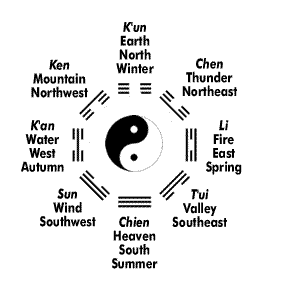
This octagonal inkcake was formed with the design of a celestial horse carrying Taoist scriptures over the water on the front and the eight trigrams and yinyang symbol on the reverse.

Plaster casts from Yaxchilan


These casts show door and window surrounds from the Maya city of Yaxchilan, Mexico constructed between AD 350 and 850. The casts were taken from Structure 33, one of the finest buildings at Yaxchilan. King Bird Jaguar IV commissioned the building, but he died before it was finished. Bird jaguar's son Itzamnaaj B'alam III, completed the temple to honour his father.
The English pioneer Alfred Maudslay worked at the principle Maya sites between 1881 and 1894. Maudslay photographed his discoveries and made papier mache and plaster moulds. The moulds were used to make plaster casts in London.

Hentakoi


These weird guys are Hentakoi which I believe are from the Nicobar Islands. Hentakoi are wooden figures or boards commissioned by a menluana (doctor-priest) to identify and neutralise spirits responsible for illness or misfortune. In this way they help reassure people that action is being taken to help them. Hentakoi are usually installed in the home but some kinds are placed outside to ward off evil or to promote abundance. Those that work are kept effective through regular rituals, but those that do not may be thrown away. Some hentakoi are naturalistic, others combine different animals, or appear part human. They are often painted in vivid colours.

Saturday, March 28, 2009

Central American Flint Knife


Olmec Figurines


Runic Calendar

My apologies for the flash in some of the museum photos, I'd rather show you glared photos than none at all.

This 17th century oblong Norwegian calendar is like a clog almanac but it also has Runic lettering. Early Greek settlers had spread their alphabet throughout the world where it was often adapted into a local form, such as Etruscan, Gothic, Coptic and, in northern Europe, Runic. none of these are in use today. But the angular form of runes made them easy to cut and Scandinavian and Anglo-Saxon runes from the 4th to 14th centuries, on wood, stone and brooches provided a wealth of material for Enlightenment scholars to decipher.